







Opening an online store has never been easier. That is exactly what misleads people: the technical part has become the simplest piece of the project. What sinks a store is almost always everything else — logistics nobody thought through, terms of sale thrown together, or a checkout that loses the customer at the last moment. Let us take it in order.
Three decisions before the first line of code
Before choosing a tool, settle these three points:
- How many products? Twenty handmade items and six thousand spare parts do not call for the same solution.
- Who ships? You, from your own workshop, or a fulfilment partner? The answer changes your delivery costs, your lead times and how you handle returns.
- Who will run the store day to day? Adding a product, changing a price, processing an order: that is work every single week.
WordPress and WooCommerce: the route we recommend
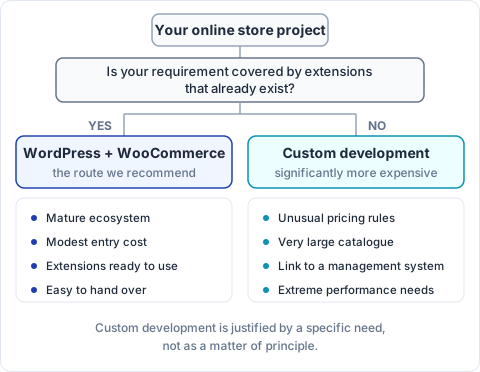
For the large majority of merchants starting out, this is the best answer, and we say so without hedging. WordPress paired with its online selling extension powers an enormous share of world e-commerce, and for good reasons.
A mature ecosystem
Everything a store needs already exists and has been tested by hundreds of thousands of sites: product variants, stock, discount codes, delivery charges by weight or zone, invoices, abandoned-basket reminders, accounting exports. You are not inventing anything; you are assembling pieces that already work.
A modest entry cost
The software itself is free. You pay for hosting, possibly a few paid plugins, and the setup work. For a merchant starting out without knowing their order volume yet, the financial risk is far more reasonable than with bespoke development.
A store somebody else can take over
This is the argument people overlook most often, and the oversight is expensive. With WordPress, if your supplier disappears, moves away or raises their rates, you will find someone to take the site over in any town in the country. That freedom to change supplier has real value.
What you accept in exchange
A WordPress store is living software: updates to apply, backups to check, hosting to size properly — a store consumes far more resources than a showcase site. Budget either the time or a maintenance contract. That is not a hidden flaw, it is the price of flexibility.
The bespoke store: more expensive, sometimes the right answer
A custom-built solution, developed specifically for you, does the job perfectly well too. Let us be blunt: it costs significantly more, and that premium is only justified in specific cases.
- Unusual pricing rules: volume discounts, negotiated prices per trade customer, automatic quotations, cut-to-size or configured products.
- A very large catalogue that general-purpose solutions struggle to serve quickly.
- Integration with your management system, so stock, orders and invoices flow without being keyed in twice.
- A need for extreme performance, where every tenth of a second shows up in revenue.
If you are in one of those cases, bespoke pays for itself. If not, it will charge you for flexibility you will never use. We build stores of that kind at Web Pulse for 1,500 EUR excl. VAT to activate: a database hosted on Cloudflare, product management, basket, online payment and a dashboard to follow your orders. The detail is on our pricing page, together with the matching monthly subscription. If the difference between these two approaches intrigues you, our article on WordPress versus static sites explains it in full.
What about hosted platforms?
Subscription-based, ready-made platforms are excellent products, and they suit a great many merchants perfectly: you have nothing to maintain. Just look at two things before you sign: the total cost once options and commissions are added, and how easily you can take your data with you the day you want to leave. These are common-sense questions, not criticisms.
Your legal obligations: the French example
This is the part guides leave out, and the one that exposes you most. We are a French company, so the framework we know first-hand is the French one — and it makes a useful example, because the same principles run right across the European Union: inform the customer, let them change their mind, protect their data. The details differ from one country to the next, so read the list below as the questions to ask, then check the answers for your own country before you open. A store selling to consumers in France must at minimum carry:
- Legal notices: the company's identity and legal form, address, contact details, business registration number (the SIRET in France, its equivalent elsewhere), VAT number, and the identity of the site's host.
- Terms and conditions of sale available before the order, covering prices, lead times, delivery arrangements, guarantees and how disputes are handled.
- The 14-day right of withdrawal for consumer customers, running from delivery. Fourteen days is the European floor, so this one travels well. You must state it clearly and provide a standard withdrawal form. Some categories are excluded, notably personalised goods and perishables: check your own case.
- The legal guarantee of conformity, which your terms of sale must set out. Two years is the European minimum; several countries give buyers longer.
- The contact details of a consumer mediator. In France every trader selling to consumers must sign up to one. This is where countries diverge most: elsewhere the duty is often only to tell customers that mediation exists, without any obligation to join a scheme. Check what yours requires.
- GDPR compliance: a privacy policy, proper consent for analytics and advertising cookies, and secure handling of customer data.
- Prices displayed inclusive of tax for consumers, with delivery costs known before the order is confirmed, and an order button that explicitly states the obligation to pay.
None of this is insurmountable, but none of it should be improvised either. Have your terms of sale reviewed by a lawyer in your own country: the outlay is modest next to a dispute.
Taking payment
Card payment through a specialist provider remains the baseline. You will be charged per transaction, usually a percentage plus a fixed amount: compare those terms, because they bear directly on your margin. Strong customer authentication is mandatory; it protects you against fraud, but poorly integrated it makes payments fail. Depending on your customers, add bank transfer or instalment payment.
VAT
Your obligations depend on your tax regime, on what you sell and on where your customers are. Selling to consumers in other European countries triggers specific rules, with a one-stop declaration scheme that saves you registering in every country. Thresholds and regimes change regularly: on this subject, trust your accountant rather than a figure read on a blog.
Logistics, delivery and returns
Weigh and measure your packed products before you open: that is what sets your shipping rates. Offer at least two options — an economy pickup-point service and home delivery — and publish lead times you will actually meet. A free-delivery threshold lifts the average basket, as long as it stays above what shipping costs you. Finally, prepare your returns procedure before the first order, not after the first complaint.
A checkout that does not lose the customer
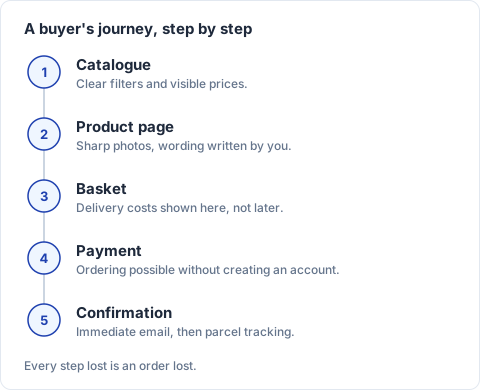
Basket abandonment turns on small things: delivery costs discovered too late, an account forced on someone when a guest order would do, too many steps. Show the total cost early, cut the number of fields to the strict minimum, and test your own buying journey on a phone before you open. Our recent work shows the standard of fluidity we aim for.
Product pages, your real source of traffic
A store is rarely found through its home page: it is found through its product pages. Never copy the supplier's description — dozens of shops have already done it, and Google knows. Write text that answers the buyer's real questions: dimensions, material, compatibility, care, lead time. Add several sharp, lightweight photos, switch on product structured data so price and availability appear in search results, and let your customers leave reviews.
Where to start, concretely
- List your products, their variants, their packed weight and their selling price.
- Choose your solution according to your catalogue and to who will run it.
- Have your terms of sale and legal notices drafted.
- Open your payment account: approval sometimes takes several days.
- Publish twenty well-made product pages rather than two hundred rushed ones.
- Place a real order yourself, end to end, before you open.
In short
For most projects, WordPress remains the safest route: mature, affordable to start, and easy to hand to someone else. The bespoke solution does the job every bit as well and costs significantly more: keep it for the requirements plugins do not cover. And remember that technology is only half the subject: the law, the logistics and your product pages will decide the rest. Browse our services to see where your project fits.
Planning an online store?
Tell us what you sell and who you sell it to. We will point you to the solution that fits your catalogue and your budget.
Talk to us about your store